


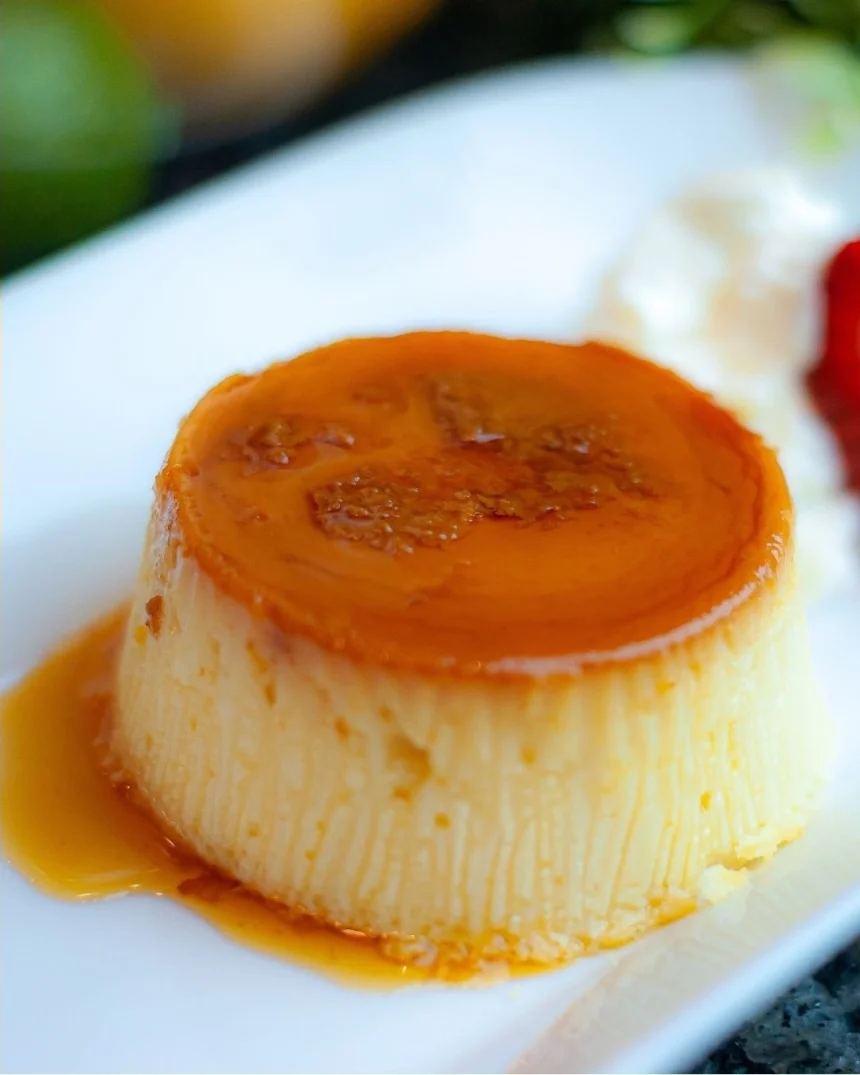
Recipe for Creamy and Irresistible Cheese Flan
Hello! We are going to prepare a spectacular dessert that combines the richness of traditional Spanish flan with the unparalleled creaminess of a cheesecake. This cheese flan has a silky texture and a slightly tart flavor thanks to the cream cheese, all bathed in a homemade golden caramel. It's an authentic recipe, much better than any restaurant's, ideal for treating your loved ones without complications.
Preparation time
Getting organized is key in the kitchen, so here's the exact breakdown of times for you to plan your baking afternoon without rushing:
- Preparation: 15 minutes
- Cooking: 50 minutes
- Additional time: 2 hours 30 minutes (cooling)
- Total: 3 hours 35 minutes
- Servings: 6
- Difficulty: Easy/Intermediate
Ingredients
To achieve that perfect balance between sweet and creamy, we will need simple ingredients that you probably already have in your pantry. The quality of the dairy is fundamental for the final result.
For the caramel
- Granulated sugar (you can use a mix of 50% white and 50% light brown if you prefer more depth) – Amount needed to cover the bottom
For the flan
- Cream cheese (Philadelphia type, preferably full-fat for extra creaminess) – 1 standard package
- Condensed milk – 1 can
- Evaporated milk – 1 can
- Eggs – Standard amount for flan (usually 4-5 depending on size, guide yourself by the texture)
- Vanilla extract – 1 teaspoon
In case you don't have cream cheese full-fat, you can use a low-fat version, although the texture will be slightly less dense. If you can't find evaporated milk, you could substitute it with whole milk reduced over heat, but it requires extra vigilance to avoid burning it.
Utensils we will use
You don't need professional equipment for this dessert; your basic kitchen tools are enough. Make sure to have the following on hand:
- Small pot or saucepan (for melting the sugar)
- Flan mold or 20 cm (8 inch) round pan
- Blender (or food processor)
- Large dish or deep tray (for the bain-marie)
- Aluminum foil
- Table knife (for unmolding)
- Large plate (for final presentation)
Step-by-step preparation of the Cheese Flan
Follow these detailed steps to achieve a confectionery result. Patience is your best ally, especially with the caramel and cooling time.
Phase 1: The Caramel
- Melt the sugar. Place the sugar in the small pot over medium-high heat. Stir constantly until it completely melts and acquires a golden amber color.
- Be careful not to leave it too long, as if it burns it will bitter the entire dessert.
- Be careful not to leave it too long, as if it burns it will bitter the entire dessert.
- Coat the mold. Immediately pour the liquid caramel into your flan mold or round mold.
- Tilt the mold with quick circular movements to cover the entire bottom and part of the sides.
- Tilt the mold with quick circular movements to cover the entire bottom and part of the sides.
- Cool the base. Let the mold rest at room temperature until the caramel is completely hard and cold.
- This can take between 20 and 30 minutes. It is vital that it is cold so as not to cook the eggs prematurely.
- This can take between 20 and 30 minutes. It is vital that it is cold so as not to cook the eggs prematurely.
Phase 2: The Mixture
- Preheat the oven. Turn on your oven to 175°C (350°F) so it is at the correct temperature when you finish the mixture.
- Blend the ingredients. In the blender cup, place the cream cheese, condensed milk, evaporated milk, eggs, and vanilla.
- Blend at medium speed until you get a homogeneous and silky mixture.
- Blend at medium speed until you get a homogeneous and silky mixture.
- Remove bubbles. Gently tap the blender jar against the countertop a couple of times.
- This helps break up large air bubbles that could affect the smooth texture of the flan.
- This helps break up large air bubbles that could affect the smooth texture of the flan.
Phase 3: The Baking
- Pour the mixture. Pour the contents of the blender into the mold, over the already hardened caramel.
- Cover with foil. Cover the mold with aluminum foil, making sure to seal the edges well so no water gets in.
- Prepare the water bath. Place your covered mold inside the large baking dish or tray.
- Pour hot water into the large dish until it covers half the height of your flan mold.
- Pour hot water into the large dish until it covers half the height of your flan mold.
- Bake. Carefully place everything in the oven and cook for 50 to 60 minutes.
- Check for doneness. After the time has passed, carefully lift a corner of the foil (watch out for steam).
- The flan should be firm at the edges but with a slight movement («jiggle») in the center, similar to set gelatin.
- The flan should be firm at the edges but with a slight movement («jiggle») in the center, similar to set gelatin.
To finish and serve
Once out of the oven, remove the mold from the water and let it cool to room temperature for about an hour. Then, refrigerate it for at least 2 hours, although overnight is ideal; this allows the caramel to liquefy and create that delicious sauce. To serve, run a thin knife around the entire edge to loosen it. Place a large inverted plate over the mold and flip it with a quick, confident motion. Done! Drizzle it with the caramel remaining at the bottom and serve it cold. If you like desserts with similar textures, you'll love trying this one. Neapolitan flan which is also a delight.
Nutritional Information
Here are the estimated values for each serving of this delicious dessert, so you can integrate it into your diet in an informed way:
- Calories: 219 kcal
- Proteins: 6 g
- Fats: 7 g
- Carbohydrates: 30 g
- Fiber: 0 g
- Sugars: 29 g
- Saturated Fats: 3 g
- Cholesterol: 164 mg
- Sodium: 88 mg
Note: Daily value percentages are based on a 2000 calorie diet. Values may vary depending on the specific brands of ingredients used.
5 keys to make it perfect
Making a flan seems simple, but the difference between a good one and an extraordinary one lies in the details. Here I share my secrets so that it turns out perfectly the first time.
- Room temperature ingredients: Take the cream cheese and eggs out of the fridge about 30 or 45 minutes before starting. If the cheese is cold, it is very likely that small lumps will remain in the mixture that will not dissolve when baked. We want a completely smooth and creamy.
- The caramel point: Don't let the caramel get too dark. A medium amber color is perfect; if it turns dark brown, it will taste bitter and ruin the sweetness of the milk condensed. If it's your first time, use medium-low heat for more control.
- The Bain-Marie is sacred: Don't try to bake it directly. The water dampens the heat and allows for slow, even cooking. Without the water, the egg would «scare» from the direct heat, creating a lumpy texture (like sweet scrambled eggs) instead of a smooth cream. It's the same delicate technique we use for crème brûlée.
- Be careful with overbeating: When using the blender, don't leave it on forever. We only need to integrate. If you incorporate too much air, the flan will come out with holes or bubbles inside. If you see a lot of foam on top before baking, remove it with a spoon.
- Resting is non-negotiable: I know the temptation is great, but unmolding a warm flan is a recipe for disaster (it will break). The cold from the fridge sets the fat from the cheese and the protein from the egg, giving it structure. Plus, the dessert tastes much better one or two days later, when the flavors have melded.
When is it ideal to enjoy it?
This Cheese Flan it is extremely versatile. Due to its richness and substance, it is the perfect ending to a Sunday family meal or special celebrations like Christmas, where we seek flavors that comfort the soul. Its elegance makes it suitable for formal dinners, but its simplicity makes it a favorite to keep in the fridge for an afternoon treat.
Personally, I think it shines brightest when served well chilled accompanied by a strong espresso or a «carajillo,» as the bitterness of the coffee wonderfully cuts through the sweetness of the caramel. It's also excellent for summer, as it doesn't need to be served hot. If you're looking for something lighter for everyday, you might prefer to alternate with a light cheesecake, but for occasions where you want to impress, this flan is king.
Comparison table
Sometimes we get confused among so many varieties of flans and similar desserts. Here I show you how our protagonist stands out from other popular options.
| Recipe | Key ingredients | Difference/advantage |
|---|---|---|
| Cheese Flan (This recipe) | Cream cheese, condensed milk, eggs | Denser and creamier texture, cheesecake-like flavor. |
| Traditional Flan (Neapolitan) | Eggs, milk, sugar, vanilla | Lighter, more gelatinous texture, and more pronounced egg flavor. |
| Chocoflan (Impossible Cake) | Chocolate batter, flan mixture | Combines cake and flan in a single two-layer dessert. |
| Coconut Flan | Coconut milk, shredded coconut | Intense tropical flavor and grainy texture from the coconut. |
| Jericalla | Milk, cinnamon, vanilla | Typical of Guadalajara, it's baked until the surface is burnt (without liquid caramel). |
| Tocino de Cielo | Only egg yolks and syrup | Much sweeter, intense yellow color, and dairy-free. |
| Creme Brûlée | Cream, yolks, burnt sugar | Smooth custard texture with a crispy sugar crust on top, not liquid. |
Frequently asked questions (FAQ)
Share your experience
Cooking is for experimenting and sharing. I'd love to know how this flan turned out for you, if you decided to add a touch of rum or if you accompanied it with fresh fruits. Leave your comment below and share your own little tricks so we can all keep learning!
Culinary glossary
To make you feel at home in the kitchen, here are some terms we've used today:
- Water bath: An indirect cooking technique where a container with food is placed inside a larger one with hot water. It serves to cook gently and evenly, ideal for flans and chocolates.
- Set: The process by which a liquid (such as an egg and milk mixture) transforms into a solid or semi-solid due to the action of heat or a coagulating agent.
- Unmold: The action of removing a preparation from its mold while preserving its shape. In the case of flan, it requires detaching the edges and flipping it decisively.
- Caramel: Sugar melted and browned over heat. It goes through several stages (syrup, soft ball, hard ball) until it becomes liquid caramel which then crystallizes upon cooling.
- Temper: In this context, we refer to taking ingredients (cheese, eggs) out of the refrigerator so they reach room temperature before use, facilitating their emulsification.




I tried it today. I loved how clear the explanation is. It earned a place in my recipe book.
Very practical and tasty, this ‘Cheese Flan’. super easy to follow, ideal for beginners.
I prepared it exactly as this ‘Cheese Flan’.