


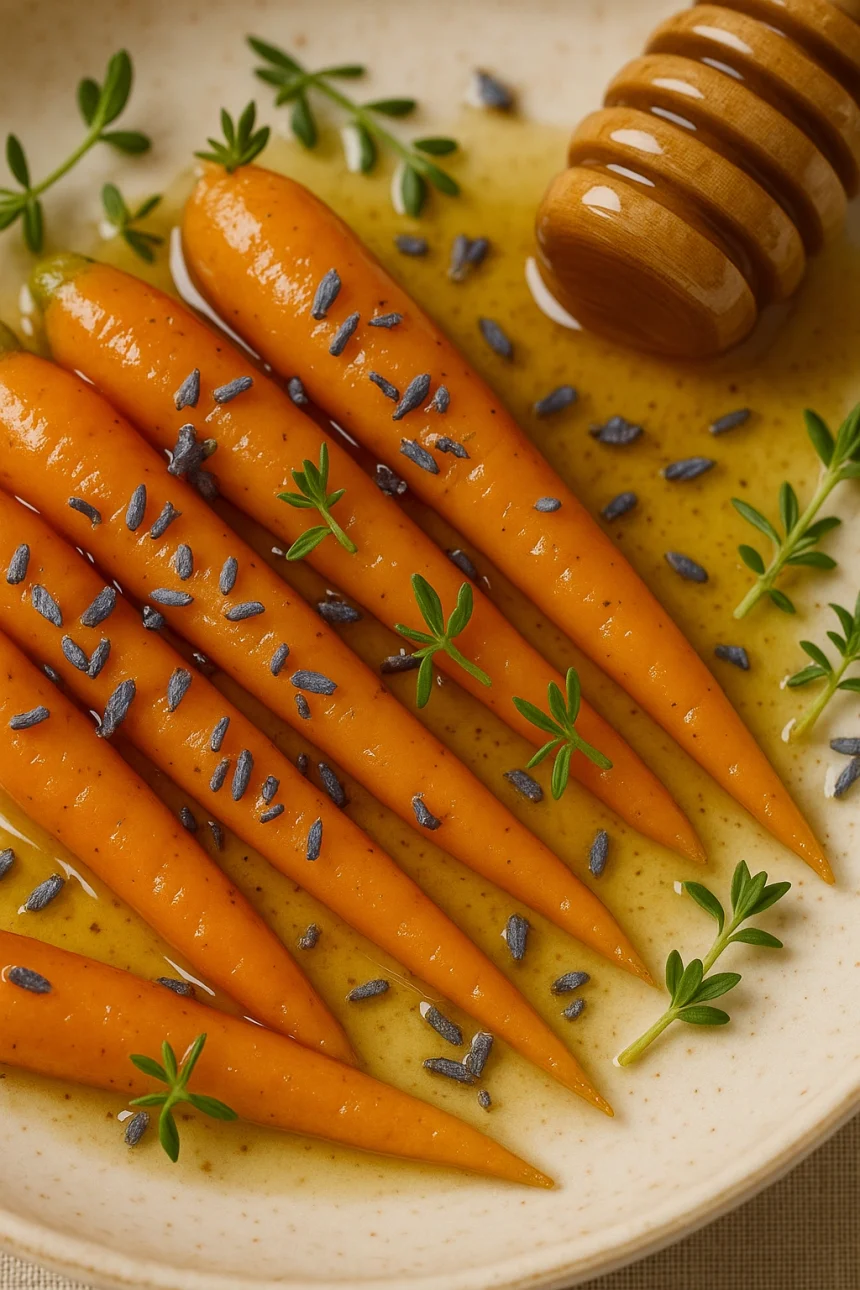
Recipe for Baby Carrots with Lavender Honey and Thyme: Irresistible and Bright!
Hello! We are going to prepare a side dish that steals the spotlight on the table due to its vibrant color and sophisticated flavor. These carrots combine the natural sweetness of the vegetable with the floral touch of honey and the freshness of herbs, creating a perfect balance between tender and aromatic that benefits any menu.
- Recipe for Baby Carrots with Lavender Honey and Thyme: Irresistible and Bright!
- Preparation time
- Ingredients
- Utensils we will use
- Step-by-step preparation
- Initial cooking in water
- Draining and resting
- Start of sautéing with butter
- Final glaze with honey and spices
- To finish and serve
- Nutritional Information
- 5 keys to make it perfect
- When is it ideal to enjoy it?
- Comparison table
- Frequently asked questions (FAQ)
- Share your experience
- Culinary glossary
Preparation time
Organizing yourself in the kitchen is essential to enjoy the process without stress. Here is the time breakdown so you can plan your cooking perfectly.
- Preparation: 5 minutes
- Cooking: 14 minutes
- Total: 19 minutes
- Servings: 2 people
- Difficulty: Easy
Ingredients
To achieve that characteristic flavor and ideal texture, we will stick to these quantities. The quality of the honey will make a difference in the final finish.
- 200 g baby carrots (you can use Jet Extramar or fresh if you find them)
- 40 g butter (preferably unsalted to control seasoning)
- 2 tsp thyme (fresh or dried, although fresh adds more aroma)
- 1 tsp dill
- 1 tsp balsamic vinegar
- 2 tsp honey (ideally lavender honey for this recipe)
- Salt (to taste)
- Pepper (to taste, freshly ground is better)
Possible substitutions
If you can't find baby carrots, you can use large carrots, peeled and cut into sticks or thick, uniform slices, although the boiling time might vary slightly. If you don't have lavender honey, you can use honey and thyme glazed carrots using wildflower or acacia honey, which are mild and don't overpower the vegetable's flavor.
Utensils we will use
We don't need sophisticated equipment for this dish, but having the right tools on hand ensures a perfect and even glaze.
- Medium pot (for the initial boiling)
- Colander or strainer
- Large skillet (where the carrots can fit without overcrowding)
- Wooden or silicone spoon or spatula
- Cutting board (if you need to adjust any size)
- Basic kitchen knife
Step-by-step preparation
The secret to this recipe lies in double cooking: first we soften the carrot fibers and then we dress them with flavor by sautéing. Follow these steps to get a restaurant-quality result.
Initial cooking in water
The first thing we're going to do is bring a pot of abundant water to a boil. It's not necessary to over-salt the water at this point.
- When the water is at a rolling boil (strong bubbling), carefully add the carrots, being careful not to splash.
- Let them boil for about 7 minutes. We want them to lose their extreme hardness but maintain their shape.
- When the water is at a rolling boil (strong bubbling), carefully add the carrots, being careful not to splash.
- Let them boil for about 7 minutes. We want them to lose their extreme hardness but maintain their shape.
Draining and resting
Moisture control is key before moving on to the fat (butter).
- Once the carrots are tender (you can test by piercing one with a toothpick), remove them from the heat.
- We pass them through the colander and drain very well. We set aside for a moment so that the excess surface water evaporates.
- Once the carrots are tender (you can test by piercing one with a toothpick), remove them from the heat.
- We pass them through the colander and drain very well. We set aside for a moment so that the excess surface water evaporates.
Start of sautéing with butter
Now we are going to give them color and fatty flavor, which will help transport the aromas of the spices.
- In a hot pan over medium heat, we melt the butter. Watch that it doesn't burn or turn dark brown.
- When it is completely melted and gently bubbling, we add the drained carrots.
- We add a pinch of salt at this moment to enhance the natural flavor.
- Sauté for about 2 minutes, moving the pan so that they are well coated with the butter.
- In a hot pan over medium heat, we melt the butter. Watch that it doesn't burn or turn dark brown.
- When it is completely melted and gently bubbling, we add the drained carrots.
- We add a pinch of salt at this moment to enhance the natural flavor.
- Sauté for about 2 minutes, moving the pan so that they are well coated with the butter.
Final glaze with honey and spices
This is the moment where the magic happens and that delicious shiny and sticky layer forms.
- We incorporate the balsamic vinegar, which will provide an interesting acidic counterpoint.
- We add the honey and spices (thyme and dill).
- Sauté everything together for about 5 minutes. The goal is for the honey and vinegar to reduce and coat each carrot.
- You will see that the sauce thickens slightly. When they are ready and shiny, we remove them from the heat.
- We incorporate the balsamic vinegar, which will provide an interesting acidic counterpoint.
- We add the honey and spices (thyme and dill).
- Sauté everything together for about 5 minutes. The goal is for the honey and vinegar to reduce and coat each carrot.
- You will see that the sauce thickens slightly. When they are ready and shiny, we remove them from the heat.
To finish and serve
Just before serving them, you can give a final dash of black pepper to awaken the sense of smell. Serve hot so that the glaze maintains its fluid texture. They are the ideal accompaniment for meats with character, such as a good brisket in wine, as the sweetness of the carrot cuts through the intensity of the meat. If you want an extra touch of color, you can sprinkle a little additional fresh thyme on top.
Nutritional Information
Although we are looking at a dish that includes butter and honey, the base is a vegetable full of properties. Here are the estimated values for each serving.
- Calories: 165 kcal
- Proteins: 1.5 g
- Fats: 10 g
- Carbohydrates: 18 g
- Fiber: 3.5 g
Note: Nutritional values are approximate and may vary depending on the specific brand of butter or the density of the honey used.
5 keys to make it perfect
Sometimes, the simplest recipes are those that require more attention to detail to go from «good» to «excellent.» Here I share my secrets for these carrots.
The exact boiling point
Don't exceed 7 minutes in the water phase. If you cook them too much at the beginning, they will fall apart when sautéing them in the pan and you'll lose that pleasant texture when biting. We want them tender but whole.
2. The glaze emulsion
Balsamic vinegar not only adds flavor; it helps to «cut» the greasy sensation of butter and balances the excessive sweetness of honey. If you like to experiment, you can try other sweet and sour vegetable variations like some steamed vegetables with vinaigrette to understand how acid lifts the flavor of vegetables.
3. Pre-drying
It is vital that you drain the carrots well before putting them in the butter. If they have too much water, the oil (or butter in this case) will splatter and, what's worse, the carrots will steam instead of sautéing and browning slightly.
4. Honey temperature
Honey burns quickly if the heat is too high. Keep the heat medium or medium-low during the last 5 minutes. We want it to caramelize gently, not turn into bitter caramel.
5. The herbs at the right time
We add thyme and dill towards the end (step 4) so that the heat releases their essential oils without burning the leaves. If you were to add them from the beginning with the butter, they could make the final result bitter.
When is it ideal to enjoy it?
These carrots have an elegant presence that makes them perfect for festive occasions or Sunday dinners. Their bright orange color brightens any table, especially in winter or during the Christmas holidays, where they wonderfully accompany roasts. However, due to their speed (less than 20 minutes), they are totally viable for a Tuesday dinner where you want to eat something comforting and homemade without complicating your life. If you are looking for options to vary your weekly menu, you could alternate this dish with a roasted vegetable casserole to keep vegetable intake fun and tasty.
Comparison table
It is common to confuse different cooking methods for carrots or to look for similar alternatives. Here I show you how our recipe stands out from other popular options.
| Recipe | Key ingredients | Difference/advantage |
|---|---|---|
| Baby carrots with honey and thyme | Honey, butter, thyme | Bright finish and intense sweet-herbal flavor. |
| Simple boiled carrots | Water, salt | Lighter, but with a much flatter flavor and soft texture. |
| Classic glazed carrots | Sugar, butter | They use sugar instead of honey, giving a less complex sweetness. |
| Carrot puree | Milk/cream, butter | Creamy texture, ideal for those who don't want to chew the whole piece. |
| Oven-roasted carrots | Olive oil, rosemary | Drier texture and toasted caramelization, take longer. |
| Lemon and rosemary chicken (Garnish included) | Chicken, lemon, chopped carrot | The carrot is cooked in the chicken juices, saltier flavor. |
| Raw carrot sticks | Carrot, lemon, chili | Totally crunchy and fresh, served cold as a snack. |
Frequently asked questions (FAQ)
Share your experience
The kitchen is a laboratory of flavors and I would love to know how you did with this recipe. Did you dare to use lavender honey or did you try another variety? What main dish did you pair these beauties with? Comments are open for you to tell us your variations or if you applied any personal trick. Your experience helps other cooks lose their fear and enjoy more!
Culinary glossary
So you don't get lost in any step, here is the meaning of some terms we have used during the recipe.
- Sauté
- To cook a food over high heat in a pan with little fat (butter or oil), stirring constantly so that it browns on the outside without burning and retaining its texture and internal juices.
- Glaze
- Cooking technique that consists of coating a food with a shiny liquid, generally sweet or reduced (like our honey and butter mixture), to give it a lustrous and appetizing appearance.
- Reduction
- The process of boiling a sauce or liquid (such as vinegar and honey) so that part of the water evaporates, thus concentrating the flavors and thickening the consistency.
- Al dente
- Expression indicating that the food (pasta or vegetable) is cooked but offers a slight resistance when bitten, being neither raw nor mushy.
- Emulsify
- To mix two liquids that normally do not combine easily (such as butter fat and vinegar acid) to form a homogeneous and creamy sauce.




This ‘Baby carrots with lavender honey and thyme’ turned out delicious at home. I loved how clear the explanation is. I loved how it combines with toasted walnuts. .
I tried this ‘Baby carrots with lavender honey and thyme’ today. It turned out delicious, thanks for the tips. perfect for Sunday.
This ‘Baby carrots with lavender honey and thyme’ turned out better than I expected. It turned out delicious, thanks for the tips. We all loved it.