
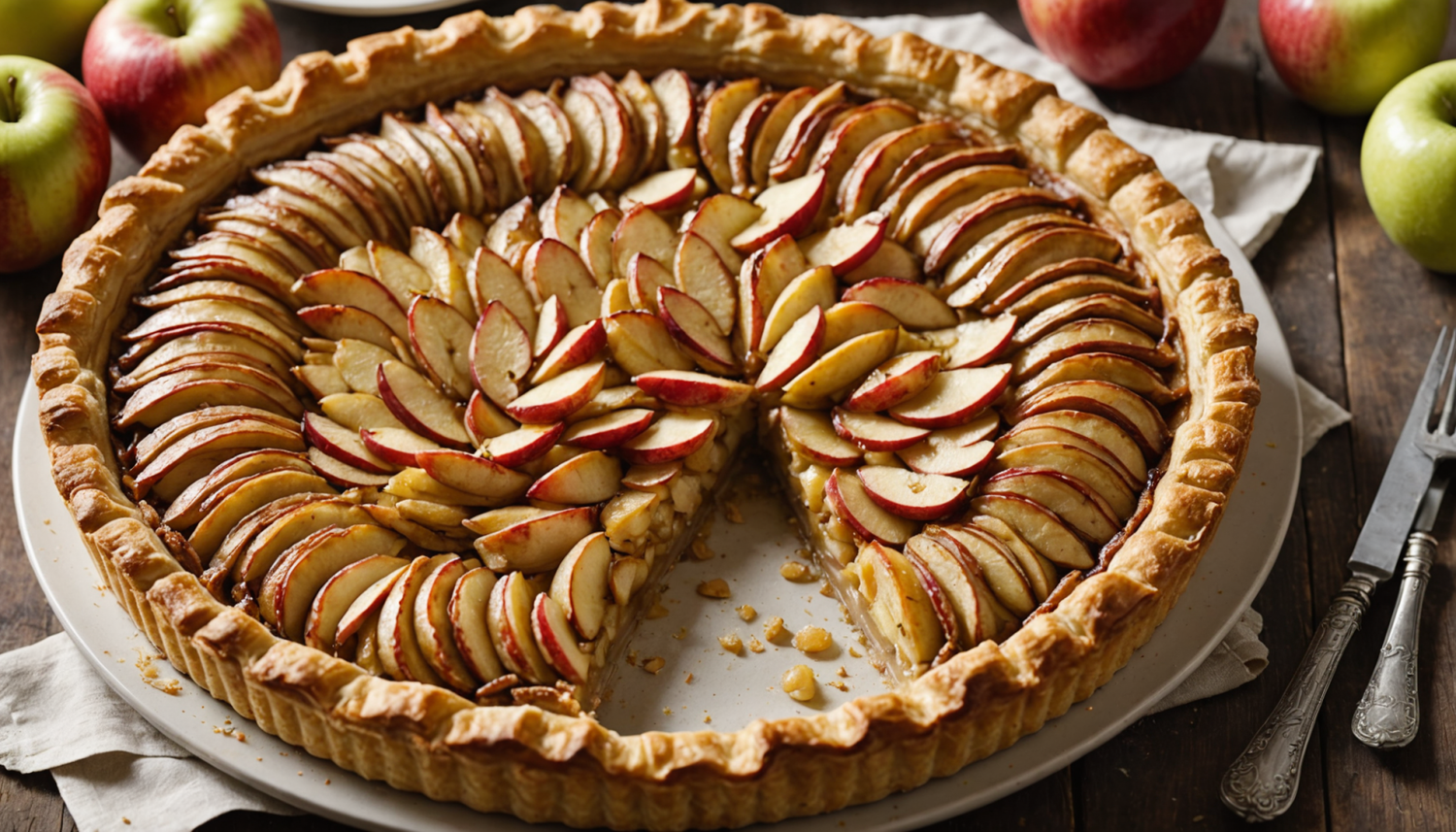
Rustic Apple Tart Recipe: The Homemade Recipe That Will Make You Fall in Love!
Hello! We're going to prepare a tart that's a pure hug for the heart. A crispy base, tender apples, and that cinnamon aroma that fills the kitchen; it's perfect for losing your fear of baking and looking like a queen without complicating your life.
Preparation time
Before putting on our apron, it's good to know how long this delight will take us to organize ourselves well in the kitchen.
- Preparation: 20 minutes
- Cooking: 25 minutes
- Total: 45 minutes
- Servings: 6 people
- Difficulty: Easy
Ingredients
For this recipe, we need ingredients that you surely already have or can easily find in the store. The quality of the fruit is key here.
For the base and filling
- 1 sheet of puff pastry (rectangular or round)
- 2 large apples (Granny Smith or Reineta type)
- 1 tablespoon brown sugar
- 1 teaspoon ground cinnamon
- 1 egg white (the secret for the base)
For the glossy finish
- 1 whole egg (for brushing edges)
- 2 tablespoons of apricot jam
- 1 tablespoon of water
- Chopped walnuts (Optional)
If you don't have apples of the indicated variety in your fruit bowl, don't worry. You can use Golden apples, although they will be a bit sweeter and softer. If you prefer to change fruit entirely, this technique works wonderfully with pears, similar to how we would do in a pear and almond pie, slightly adjusting the sugar if the fruit is very ripe.
Utensils we will use
- Flat baking sheet
- Baking paper (parchment paper or greaseproof paper)
- Sharp knife and cutting board
- Fork
- Kitchen brush (silicone or bristle brush)
- Small mixing bowl
- Small saucepan or microwave-safe mug
Preparation
Preheat and prepare the base
The first thing is to turn on the oven. We need a strong burst of heat for the puff pastry to rise.
- Preheat the oven to 200°C (400°F).
- Unroll the puff pastry directly onto the paper it usually comes with or onto a sheet of baking paper on your tray.
- With a fork, prick the entire central surface of the dough, leaving a border of about 5 centimeters unpricked. This helps prevent the center from puffing up too much.
- Preheat the oven to 200°C (400°F).
- Unroll the puff pastry directly onto the paper it usually comes with or onto a sheet of baking paper on your tray.
- With a fork, prick the entire central surface of the dough, leaving a border of about 5 centimeters unpricked. This helps prevent the center from puffing up too much.
The secret to the crispy base
Here we apply «Sofia's Secret» to prevent the apple juices from moistening the dough and making it raw.
- Lightly beat the egg white in a bowl.
- With the brush, paint the entire central area of the dough (where the apples will go).
- This layer of egg white creates an impermeable barrier that cooks quickly and protects the puff pastry.
- Lightly beat the egg white in a bowl.
- With the brush, paint the entire central area of the dough (where the apples will go).
- This layer of egg white creates an impermeable barrier that cooks quickly and protects the puff pastry.
Cut and arrange the apples
The rustic presentation has its charm in imperfection, but the cut must be even for even cooking.
- Peel the apples, core them, and cut them in half.
- Slice each half into thin slices (approx. 3-5 mm thick).
- Arrange the slices in a fan shape or overlapping rows over the area painted with egg white, respecting the 5 cm free edge.
- If you like to experiment with textures like in a apple oat crumble, you can sprinkle the optional chopped walnuts here.
- Peel the apples, core them, and cut them in half.
- Slice each half into thin slices (approx. 3-5 mm thick).
- Arrange the slices in a fan shape or overlapping rows over the area painted with egg white, respecting the 5 cm free edge.
- If you like to experiment with textures like in a apple oat crumble, you can sprinkle the optional chopped walnuts here.
Season and form the rustic edge
Now we give it flavor and that characteristic shape that holds the filling.
- Mix the brown sugar with the cinnamon in a bowl.
- Generously sprinkle this mixture over the apples.
- Fold the free dough edge towards the center, partially covering the outer apples. It doesn't have to be perfect, irregular folds are beautiful.
- Mix the brown sugar with the cinnamon in a bowl.
- Generously sprinkle this mixture over the apples.
- Fold the free dough edge towards the center, partially covering the outer apples. It doesn't have to be perfect, irregular folds are beautiful.
Golden baking
For the tart to be visually appealing, color is essential.
- Beat the whole egg with a drop of water.
- Carefully brush all the dough edge we just folded.
- Bake in the oven for 20-25 minutes.
- Look for signs of doneness: the dough should look nicely golden and puffed, and the apples tender when pricked.
- Beat the whole egg with a drop of water.
- Carefully brush all the dough edge we just folded.
- Bake in the oven for 20-25 minutes.
- Look for signs of doneness: the dough should look nicely golden and puffed, and the apples tender when pricked.
The final shine
While it bakes, we prepare the glaze that will bring the fruit to life.
- Heat the apricot jam with the tablespoon of water in a saucepan or microwave until liquid.
- Take the tart out of the oven and, while hot, gently brush the apples with the diluted jam.
- Heat the apricot jam with the tablespoon of water in a saucepan or microwave until liquid.
- Take the tart out of the oven and, while hot, gently brush the apples with the diluted jam.
To finish and serve
Once you have brushed the apples to give them that pastry shine, let the tart rest on a wire rack for at least 15 minutes. This allows the puff pastry to settle and not break when cut. Serve the portions warm; it's the ideal time to enjoy the contrasts. Accompany it with a scoop of vanilla ice cream that slowly melts over the hot fruit, or if you prefer something less cold, a spoonful of crème fraîche or unsweetened whipped cream works great to balance the sweetness.
Nutritional Information
These values are approximate estimates per serving for your reference.
- Calories: 280 kcal
- Proteins: 4 g
- Fats: 14 g
- Carbohydrates: 36 g
- Fiber: 3 g
Note: Daily value percentages are based on a 2,000-calorie diet. Values may vary depending on the brand of puff pastry used.
5 keys to make it perfect
Sometimes the small details make the difference between a good tart and an unforgettable one. Here are my chef's tricks to ensure success.
- Dough always cold: Puff pastry needs to be very cold before going into a hot oven. If you notice it softening too much when handling it, place the assembled tray in the refrigerator 10 minutes before baking. This ensures separate and crispy layers.
- Uniform cut: Try to make sure all apple slices have the same thickness. If some are very thick and others thin, you will have raw pieces and dry ones. Consistency is key to texture.
- The egg white barrier: Don't skip the step of brushing the base with egg white. It's the best insurance against a watery base («soggy bottom») that ruins many fruit tarts.
- Don't oversaturate with sugar: Apples already have their natural sweetness, and jam adds more. Brown sugar is more for color and caramelization along with cinnamon. If you overdo it, it becomes cloyingly sweet.
- Customize the glaze: If you don't have apricot jam, you can use a light reduction of blueberry and orange compote strained for a different citrus touch and a more intense color.
When is it ideal to enjoy it?
This rustic apple tart is incredibly versatile. It's the perfect finishing touch for a Sunday family meal because it's quick to make and everyone loves it, from children to grandparents. It's also ideal for those autumn or winter afternoons when you fancy something warm with coffee or tea. As it's not an excessively heavy dessert, it works very well even after a hearty meal. Furthermore, its artisanal appearance makes it look beautiful on an informal celebration table.
Comparison table
There are many ways to enjoy apples in baking. Here I show you how our rustic version compares to other popular recipes so you can choose the best option according to your craving.
| Recipe | Key ingredients | Difference/advantage |
|---|---|---|
| Rustic Apple Tart | Puff pastry, sliced apple, cinnamon | Faster and easier, no specific mold, crispy base. |
| German Tart (Apfelkuchen) | Shortcrust pastry, cream, diced apple | Creamier and softer texture, similar to a German apple pie traditional. |
| American Apple Pie | Double shortcrust pastry, many spices, butter | It's deeper, has a pastry lid, and the filling is much more abundant and juicy. |
| Tarte Tatin | Caramelized apples, inverted pastry | Cooked upside down in a pan, intense caramel flavor and soft texture. |
| Apple Strudel | Very thin filo dough, raisins, walnuts | Extremely thin and rolled dough, spicier and drier filling. |
| Apple Crumble | Diced fruit, flour and butter topping | No base, just baked fruit with a sandy and crunchy topping. |
| Apple Turnovers | Dough disks, cooked filling | Individual and closed format, ideal for taking away or eating by hand. |
Frequently asked questions (FAQ)
Share your experience
Cooking is for experimenting and sharing. Leave your comment and share your own little tricks! Did you add nuts? Did you serve it with ice cream? I would love to know how it turned out for you and if you achieved that crispy base we're all looking for.
Culinary glossary
- Slice: To cut a food, in this case fruit, into very thin and uniform slices or sheets.
- Brush/Glaze: To apply a thin layer of liquid (egg, jam, oil) over a food using a kitchen brush to give color or shine.
- Preheat: To turn on the oven a few minutes before putting in the preparation so that it reaches the correct temperature from the first second of cooking.
- Rustic: In cooking, it refers to a less formal and perfect presentation, made freehand without rigid molds, valuing the homemade look.
- Cooking point: The exact moment a food is ready; in baking, it is usually checked visually (golden) or tactilely (firmness).
This ‘Rustic Apple Tart’ turned out delicious at home. I added a touch of lemon and it was superb.
This ‘Rustic Apple Tart’ looks incredible. I took it to a meeting and it flew off the table.
Simple and delicious. I prepared it yesterday and it was spectacular. Highly recommended.