


Easy and Quick Salmon Tiradito Recipe to Impress at Your Dinners
Hello! We are going to prepare a spectacular dish that, although it looks like it's from a high-end restaurant, is totally achievable in your own home. Salmon tiradito combines the freshness of raw fish with a vibrant sauce full of nuances, perfect for awakening the palate. It's a light, healthy recipe with that Peruvian touch we love so much, ideal for showing off without complicating your life.
- Easy and Quick Salmon Tiradito Recipe to Impress at Your Dinners
- Preparation time
- Ingredients
- Utensils we will use
- Preparation
- 1. The Sauce and the Fish
- 2. Fresh Preparations
- 3. The Crispies
- 4. Cutting and Assembly
- To finish and serve
- Nutritional Information
- 5 keys to make it perfect
- When is it ideal to enjoy it?
- Comparison table
- Frequently asked questions
- Share your experience
- Culinary glossary
Preparation time
Organization is key in the kitchen, especially when working with raw fish and several small preparations that come together at the end. Here's the breakdown so you can calculate your times:
- Preparation: 20 minutes
- Cooking: 10 minutes (for the crispy elements)
- Total: 30 minutes
- Servings: 4 people
- Difficulty: Easy/Intermediate
Ingredients
To achieve that authentic and fresh flavor, we need to respect the quality of the product. Here is the exact list of what we are going to use, divided by parts so you don't get confused:
For the base
- 400 g salmon, skinless and boneless (previously frozen)
For the sauce (Mango Leche de Tigre)
- 2 units of lemon (freshly squeezed juice)
- 3 tbsp mango puree (about 45 g)
- 2 tbsp coconut milk (about 30 gr)
- 1 splash of fish or seafood fumet
- 1 tbsp spice mix (celery salt, paprika, peppers, seedless red chili)
- 1 tbsp fresh cilantro and basil
For the fresh garnish
- 2 tbsp concassé tomato
- 1/2 unit red onion
- 1/2 unit cucumber
- 1 unit avocado
For the final, crispy touches
- 1 tbsp mayonnaise
- Fresh basil leaves (for the mayonnaise)
- 4 units of prawn crackers (1 per person)
- 100 gr sushi rice (optional, as a base or side)
- 1 unit of toasted and crushed nori seaweed
- 1 tbsp crunchy kikos
- 1 tbsp extra virgin olive oil
- 1 tbsp sunflower oil
In case you don't have mango puree, you can replace it with peach puree or even papaya puree to maintain the fruity and sweet texture, although the flavor will vary slightly. If you don't find prawn crackers, you can omit them or use store-bought yuca chips.
Utensils we will use
You don't need a professional kitchen, with these basics that you surely have in your drawers, we'll manage perfectly:
- Blender or stand mixer (for the fine sauce)
- Sharply sharpened knife (essential for cutting fish)
- Stable cutting board
- Medium bowl (for mixing)
- Small frying pan (for frying the crispy bits)
- Strainer or chinois (optional, to make the sauce finer)
- Kitchen paper towels
- Large flat plates (for plating)
Preparation
We are going to build this dish step by step. Don't get overwhelmed by the number of steps, you'll see that they are very simple micro-preparations that eventually assemble.
1. The Sauce and the Fish
- Preparation of the base sauce:
- Put the juice of 2 lemons, 3 tablespoons of mango puree, 2 tablespoons of coconut milk, and a splash of fish stock into the blender cup.
- Add the tablespoon of fresh cilantro and basil along with the spice mix (celery salt, paprika, peppers, red chili).
- Blend everything at maximum power until you get a fine, vibrantly colored, and completely homogeneous sauce.
- Taste the mixture and adjust the acidity or sweetness if you deem it necessary.
- Reserve this sauce in the refrigerator for at least 20–30 minutes; the cold is vital for this cold dish.
- Put the juice of 2 lemons, 3 tablespoons of mango puree, 2 tablespoons of coconut milk, and a splash of fish stock into the blender cup.
- Add the tablespoon of fresh cilantro and basil along with the spice mix (celery salt, paprika, peppers, red chili).
- Blend everything at maximum power until you get a fine, vibrantly colored, and completely homogeneous sauce.
- Taste the mixture and adjust the acidity or sweetness if you deem it necessary.
- Reserve this sauce in the refrigerator for at least 20–30 minutes; the cold is vital for this cold dish.
2. Fresh Preparations
- The chopped vegetables:
- Finely chop the 1/2 red onion (brunoise).
- Cut the 1/2 cucumber into thin slices or small cubes, depending on your preferred texture.
- In a bowl, mix the concassé tomato, onion, cucumber, and a little extra chopped cilantro if you like. Set aside.
- Finely chop the 1/2 red onion (brunoise).
- Cut the 1/2 cucumber into thin slices or small cubes, depending on your preferred texture.
- In a bowl, mix the concassé tomato, onion, cucumber, and a little extra chopped cilantro if you like. Set aside.
- The quick guacamole:
- Cut the avocado unit and remove the flesh.
- In a small bowl, mash the avocado with a fork.
- Add a few drops of lemon and salt. We are looking for a creamy and dense guacamole, without excess liquid so that it maintains its shape on the plate.
- Cut the avocado unit and remove the flesh.
- In a small bowl, mash the avocado with a fork.
- Add a few drops of lemon and salt. We are looking for a creamy and dense guacamole, without excess liquid so that it maintains its shape on the plate.
- The herb mayonnaise:
- Crush or finely chop a few fresh basil leaves.
- Mix them with the tablespoon of mayonnaise until you achieve a smooth and aromatic green cream.
- Crush or finely chop a few fresh basil leaves.
- Mix them with the tablespoon of mayonnaise until you achieve a smooth and aromatic green cream.
3. The Crispies
- Wafers and Rice:
- Put the pan on the heat with sunflower oil. When hot, fry the 4 prawn crackers one by one. You will see them puff up in seconds. Remove them and drain them on absorbent paper.
- If using sushi rice (optional), sauté or lightly fry it in the same pan along with the chopped nori seaweed until golden. Let cool and break into irregular pieces for texture.
- Put the pan on the heat with sunflower oil. When hot, fry the 4 prawn crackers one by one. You will see them puff up in seconds. Remove them and drain them on absorbent paper.
- If using sushi rice (optional), sauté or lightly fry it in the same pan along with the chopped nori seaweed until golden. Let cool and break into irregular pieces for texture.
- The final corn touch:
- Take the tablespoon of kikos and lightly crush them in a mortar or with the bottom of a glass, leaving coarse fragments to maintain the powerful crunch.
- Take the tablespoon of kikos and lightly crush them in a mortar or with the bottom of a glass, leaving coarse fragments to maintain the powerful crunch.
4. Cutting and Assembly
- Salmon Cut:
- Take the salmon out of the cold. With a sharp knife, cut the fish very thinly, sashimi style (slices about 3-4 mm thick).
- Place the slices on the plate forming a uniform base, covering the bottom without piling them up too much.
- Add a pinch of salt over the raw fish.
- Take the salmon out of the cold. With a sharp knife, cut the fish very thinly, sashimi style (slices about 3-4 mm thick).
- Place the slices on the plate forming a uniform base, covering the bottom without piling them up too much.
- Add a pinch of salt over the raw fish.
To finish and serve
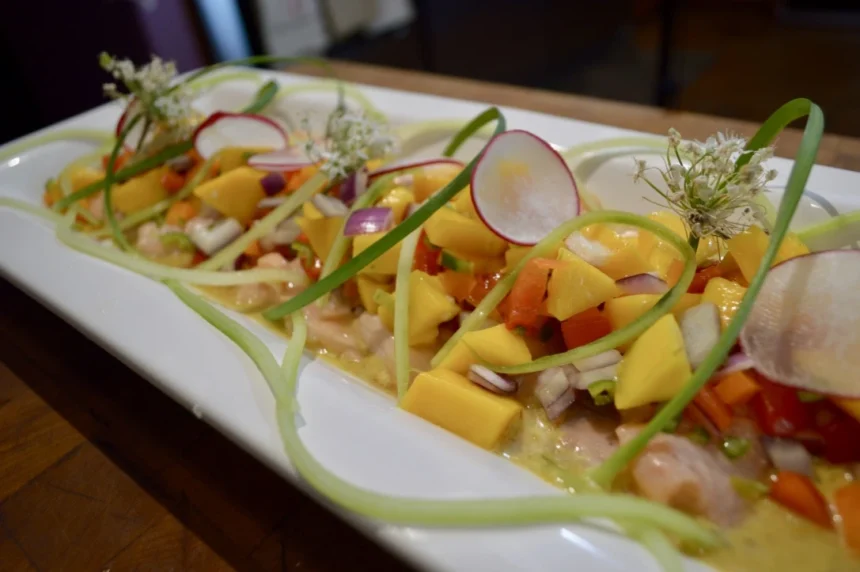
The artistic moment arrives. Take the sauce out of the fridge and lightly bathe the salmon; there's no need to drown it, we want to see the fish. Aesthetically distribute the fresh chopped vegetables on top. With the help of two small spoons or an improvised pastry bag (a bag with a cut tip), place dots of guacamole and basil mayonnaise alternately. Scatter the pieces of rice with nori and crushed kikos for the crunchy contrast. Finally, decorate with shrimp crackers on one side or chopped on top and, if you have them, some microgreens to add height. Serve immediately, very cold. If you have leftover salmon, you can always try another version like the salmon tiradito with yellow pepper and lemon to compare flavors.
Nutritional Information
It's important to know what we are eating, and the good news is that this tiradito is quite balanced. Here are the estimated values per serving:
- Calories: 320 kcal
- Proteins: 22 g
- Fats: 18 g
- Carbohydrates: 15 g
- Fiber: 3 g
Note: Values are approximate estimates per serving and may vary depending on the exact size of the avocados or the amount of sauce you ultimately use in the dish.
5 keys to make it perfect
Sometimes the difference between a good dish and a memorable one lies in the small details. Here are my secrets for this tiradito:
- Temperature is law: The fish must be very cold when cutting and serving it. If the sauce warms up, the emulsion loses its appeal. Keep everything refrigerated until the last second.
- The cut determines the texture: Don't cut the salmon as if it were a fillet for grilling. You need thin slices so that the sauce «embraces» them well and they melt in your mouth. A sharp knife is non-negotiable here.
- Sauce balance: Mango provides sweetness and lemon acidity. Taste your mango puree beforehand; if it's too sweet, increase the lemon or chili a bit. You should look for that point where your mouth waters when you taste it.
- Do not let it marinate: Unlike ceviche, which sometimes rests, tiradito is bathed and served. If you leave it for too long, the lemon acid will «cook» the fish and it will lose that silky sashimi texture.
- Play of textures: Don't skip the kikos or the crackers. Eating everything soft bores the palate. That «crack» of the toasted corn against the smoothness of the avocado and salmon is what makes the dish fun.
When is it ideal to enjoy it?
This salmon tiradito is the king of hot days or when you're looking for a dinner that won't leave you feeling heavy. It's fantastic as appetizer at a dinner with friends where you want to impress without getting hot in the kitchen while they are at home. It also works wonderfully for a romantic meal, as it is light and aesthetically beautiful. Being a cold dish, it is the undisputed star of summer, but the richness of salmon makes it suitable for year-round if you are looking for a touch of freshness.
Comparison table
To help you understand where our tiradito stands compared to other similar raw fish dishes, I have prepared this table. Note the differences to choose what to prepare according to the occasion.
| Recipe | Key ingredients | Difference/advantage |
|---|---|---|
| Salmon Tiradito (This recipe) | Salmon, mango, lemon, chili | Sashimi-style cut, sweet-sour sauce, not marinated. |
| Classic Ceviche | White fish, lime, onion, cilantro | The fish is «cooked» in the acid for longer, diced. |
| Salmon Ceviche | Salmon, citrus, avocado | Same fish but diced and with longer marinating time. |
| Japanese Sashimi | High-quality raw fish, soy, wasabi | Without covering sauce, total purism in the fish flavor. |
| Carpaccio | Meat or fish, oil, lemon, parmesan | Extremely thin cut, fattier dressing (oil) and less acidic. |
| Salmon Tartare | Knife-chopped salmon, capers, mustard | Chopped and unctuous texture, more Western flavors. |
| Yellow Chili Tiradito | White fish, yellow chili paste, lemon | The most traditional Peruvian version, spicier and less fruity. |
Frequently asked questions
Share your experience
Cooking is for experimenting and sharing. I'd love to know how this tiradito turned out for you. Did you dare to use spice? Did you change the mango for another fruit? Leave your comment and share your own little tricks so we can all learn new ways to enjoy it!
Culinary glossary
So you don't get lost with some terms we've used, here I explain what they mean in a simple way:
- Concassé: It's a fancy way of referring to peeled, deseeded, and finely diced tomato. It's used so it feels smooth in the mouth and doesn't release too much water.
- Sashimi: Japanese cutting technique for raw fish. They are slices about 3-5 millimeters thick, cleanly cut to appreciate the texture of the fish's muscle.
- Fumet: It's simply a concentrated fish or seafood broth. It's the flavor base that adds depth to sauces and rice dishes.
- Brunoise: Vegetable cut into tiny cubes, about 2 to 3 millimeters per side. Ideal for the onion to be crunchy but not bothersome when chewing.
- Emulsion: It's what happens when you mix fat (like coconut milk) with an acidic liquid (lemon) and it creates a bound, full-bodied cream, instead of being separated.






Simple and delicious. it saved me time and was delicious.
Simple and delicious, this ‘Salmon Tiradito’. I loved how clear the explanation is.
Impeccable texture and flavor, this ‘Salmon Tiradito’. I took it to a meeting and it flew off the table.