
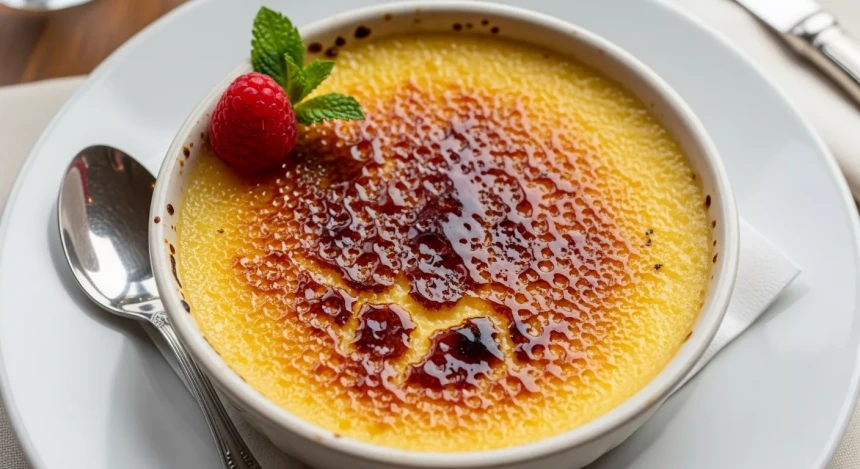
Creme Brulee Recipe
Hello! We are going to prepare a classic and elegant cream that doesn't require professional equipment. It's a comforting dessert of cream and egg yolks with a crunchy layer, ideal for surprising at home without stress and with simple ingredients.
- Creme Brulee Recipe
- Preparation time
- Ingredients
- Utensils we will use
- Preparation
- Infusing the dairy
- Beat the yolks
- Tempering the mixture
- Preparing the bain-marie
- Baking and looking for the tender point
- To finish and serve
- 5 keys to make it perfect
- 1. Avoiding foam on the surface
- 2. Exhaustive oven temperature control
- 3. The unbreakable rule of absolute cold
- 4. The leveled sprinkling technique
- 5. Extreme vigilance under the grill
- When is it ideal to enjoy it?
- Comparison table
- Frequently asked questions (FAQ)
- Share your experience and Culinary Glossary
Preparing this dish in your own kitchen might seem like a challenge reserved for high-end restaurants, but the reality is very different. The base of this dessert is simply a baked mixture of dairy and eggs. Understanding how these elements react to heat is the only real secret you need to master. By mastering this recipe, you will realize that fine pastry is based on fundamental techniques that anyone can replicate with patience and attention to detail.
Over the years, many people have told me that they avoid making these types of preparations for fear that the mixture will curdle or remain liquid. It's a completely normal fear. However, when you understand the why behind each step, that fear disappears. The magic happens when the proteins in the yolks gently intertwine with the fat in the cream, creating a firm yet incredibly silky structure on the palate.
The science behind a perfect texture
To achieve that velvety consistency, we rely almost entirely on the coagulation of the yolks. Unlike a cake that relies on flour or baking powder, here the egg is the structural protagonist. When we apply heat gradually, the egg proteins begin to unravel and form a network that traps the liquid. If the heat is too strong, that network contracts abruptly, expelling water and leaving a lumpy result.
That's why we use gentle and controlled cooking methods. We don't aim to boil the mixture, but rather to caress it with temperature. This basic principle will serve you not only for this dish, but for any sauce or cream that relies on egg for thickening. Patience is your best tool in this process, as rushing the cooking is the fastest way to an undesirable texture.
Furthermore, the contrast of temperatures is what makes the eating experience so memorable. The base must be completely cold, almost frozen, while the surface is briefly heated to melt the sugar. That thermal shock in the mouth is the unmistakable signature of a job well done in modern home cooking, where in the midst of 2026 we value authentic textures more than ever over ultra-processed products.
Overcoming the myth of special equipment
Another major mental obstacle is often the belief that you need expensive tools. It's true that in the professional sphere we use high-power blowtorches to achieve that dark crust in seconds. But in the home environment, we can take advantage of the technology of our conventional ovens. The top grill, when used carefully, is a fantastic alternative that melts the caramel evenly.
Adapting recipes to what we have in our drawers fosters true culinary creativity. There's no point in filling cupboards with gadgets we'll use once a year. Simplifying the process allows us to concentrate on what really matters: the quality of the ingredients and care in execution. Thus, this dessert becomes a viable option for a Sunday lunch or an impromptu dinner with friends.
Preparation time
Organizing your minutes in the kitchen is vital so you can enjoy the process without stress. This recipe requires very little active work, but demands resting periods that cannot be skipped. Here is the exact breakdown of the times we will manage.
- Preparation: 15 minutes
- Cooking: 35 minutes
- Total: 50 minutes (plus cooling time)
- Servings: 4
- Difficulty: Intermediate
Active preparation time refers exclusively to the moments when you are mixing, heating liquids, or pouring the mixture into containers. Those initial fifteen minutes are the heart of the recipe. During that time, you must be completely present, monitoring the temperature of the stovetops and ensuring the mixture is homogeneous. Once the containers go into the oven, your physical work is almost completely finished.
The importance of resting times
Although the total time is fifty minutes, you must consider that the cream needs to cool for several hours before you can add the crunchy layer. This cooling serves two critical functions. First, it allows the fat in the cream to solidify again, giving the cream that dense, rich consistency that holds on the spoon. If you try to eat it freshly baked, you will find a texture similar to a thick soup.
Secondly, a very cold base is the only shield that will protect the cream when we apply intense heat in the last step. If the cream is warm, the heat from the oven's broiler will melt it completely, ruining all your previous effort. Therefore, plan to make this preparation a day in advance or, at least, first thing in the morning if you plan to serve it in the evening.
The baking itself lasts between twenty-five and forty minutes, depending greatly on the particularities of your oven and the thickness of your molds. Deep containers take longer to transfer heat to the center, while wider and flatter ones cook more quickly. Learning to read the visual cues of doneness will be much more useful than strictly following the clock. We will see these cues later so you have no doubts.
Temperature of ingredients at the start
To optimize those fifteen minutes of initial preparation, it is highly recommended that you take the eggs out of the refrigerator a while beforehand. Working with egg yolks at room temperature makes it easier for them to integrate with the sugar without forming rigid lumps. Additionally, when you pour the hot liquid over them, the thermal shock will be less, drastically reducing the chances of them cooking prematurely.
Prior organization, or as we often call it, mise en place, will save you unnecessary rushing. Have your molds ready inside the baking dish, have hot water on hand, and measure everything before turning on the heat. This peace of mind translates directly into a better final result on the plate. Cooking is meant to be enjoyed, and haste is the enemy of good results.
Ingredients
The greatness of this preparation lies in its minimalism. By using so few elements, the quality of each one shines exceptionally. Selecting the correct ingredients makes the difference between a mediocre and an extraordinary result. Below, I detail exactly what we are going to use.
- Heavy cream or whipping cream (minimum 35% fat content): 2 cups (470 ml)
- Large egg yolks: 5 units
- White sugar: 1/2 cup (100 g)
- Vanilla (whole bean or pure extract): 1 teaspoon
- Common salt: 1/8 teaspoon
- Additional sugar (white or brown) for the topping: 4 teaspoons
(If you do not have a natural vanilla bean, you can replace it with a good liquid extract or vanilla paste. If you swap the bean for extract, add it at the end of heating the dairy so its aroma does not evaporate with prolonged heat).
The fundamental role of dairy fat
Heavy cream is non-negotiable in this formula. Some people try to reduce calories by using whole milk or skimmed versions, but the result is always a watery texture that fails to hold up. Fat acts as a lubricant on the palate, coating the tongue and transporting soluble flavors. Furthermore, it interferes with the coagulation of egg proteins, ensuring that the set is smooth and does not acquire a rubbery consistency similar to an overcooked flan.
If you have ever noticed that a baked cream releases water or liquid at the bottom of the container, it is usually due to a lack of fat in the base mixture. The cream stabilizes the entire system. If you want to lighten the dish, it is preferable to serve a smaller portion rather than altering the chemical balance of the components.
Understanding sugars and egg yolks
Granulated white sugar is ideal for sweetening the interior. It dissolves easily and does not impart dark flavors that would mask the delicacy of the vanilla. However, for the top layer, you can experiment. Brown sugar contains traces of molasses, which facilitates faster caramelization and provides deep toasted notes, although it tends to burn if not watched closely. White sugar on the surface offers a more transparent crust and a cleaner, more vitreous crunch.
Regarding the eggs, we exclusively use the yolks. The whites are mostly composed of water and proteins that coagulate to form very firm structures. By removing them, we are left with the richness, golden color, and emulsifying capacity of the yolks. It is important to separate the eggs when cold, as the yolk is firmer and less prone to breaking, but then let them rest a bit in the bowl before whisking.
If you have leftover egg whites, don't discard them. You can store them in an airtight container in the refrigerator for several days or even freeze them. They are perfect for making a simple meringue, light pancakes, or adding them to your breakfast scrambles to add volume without additional fat.
Utensils we will use
You don't need to empty a kitchenware store to succeed with this dessert. The homemade tools you already have in your cupboards are perfectly capable of doing the job. The important thing is to understand how these utensils interact with the oven's heat.
- Medium pot or saucepan
- Large bowl for mixing
- Hand whisk
- 4 individual molds or oven-safe bowls
- Large oven-safe dish (where the molds fit)
- Measuring jug or ladle (for pouring the mixture)
The importance of suitable molds
The ideal container is a ceramic bowl, wide and shallow. Ceramic distributes heat slowly and constantly, which protects the edges of the mixture from cooking faster than the center. If the molds are too deep, the exterior could overcook while the core remains completely liquid. If you don't have specific bowls, you can use thick ceramic coffee cups or even small glass jars suitable for high temperatures.
If you opt for glass jars, keep in mind that glass reacts differently to heat, and you might need to slightly adjust baking times. Glass allows you to see the inside, which is a visual advantage to check if the mixture has set, but it retains heat for a long time once out of the oven, so it is vital to remove them from the hot water immediately.
You must avoid at all costs using metal molds for baking individual portions of this type. Metal is an excellent thermal conductor, which is great for browning meats, but terrible for delicate cooking. It will immediately transmit the high temperature of the water to the cream, causing the edges to curdle and acquire a scrambled egg texture before the center begins to set.
Preparing the baking environment
The large dish you use must have edges high enough to contain water that reaches halfway up your individual bowls. This technique, known as a bain-marie, is the ultimate protective shield. The water will never exceed one hundred degrees Celsius, absorbing excess heat from the oven and ensuring a moist and extremely gentle cooking environment.
To safely handle boiling water, I suggest placing the empty dish on the oven rack, putting the bowls inside, and, just before closing the door, carefully pouring the hot water using a jug. Trying to transport a large tray full of boiling water from the countertop to the oven is an unnecessary burn risk that we can easily avoid with a little logical planning.
Preparation
It's time to get to work. Follow these steps without rushing. The technique is simple, but it requires your full attention during the initial stages to ensure that the textures integrate perfectly without forming lumps.
Infusing the dairy
Place the cream and salt in the pot over medium-low heat. If using the whole pod, cut it lengthwise, scrape the seeds from the inside with the tip of a knife, and add both the seeds and the empty pod to the liquid. Heat slowly until you notice small bubbles forming around the edges of the pot. Do not allow it to come to a rolling boil. Remove from heat, cover the pot, and let the mixture rest for about ten minutes for the aromas to deeply release into the fat.
Beat the yolks
In the large bowl, add the yolks and the half cup of white sugar. With the hand whisk, mix both ingredients using firm circular motions. We want the sugar to begin dissolving and the mixture to acquire a slightly paler tone, but avoid whisking vigorously up and down. We are not looking to incorporate air or create a lot of foam, as bubbles would rise to the surface during baking, ruining the smooth layer we need for the caramel.
Tempering the mixture
This is the critical step for success. Remove the empty pod from the pot. While gently and constantly whisking the yolks, pour a very thin stream of the hot cream over them. Just a little at first. This action gradually raises the temperature of the eggs without scrambling them. Once that first stream is integrated, continue adding the rest of the hot liquid little by little, stirring constantly. If you use liquid extract instead of a pod, this is the exact moment to incorporate it and mix well.
Preparing the bain-marie
Preheat your oven to about one hundred and sixty degrees Celsius. Place the four empty ramekins inside the large baking dish. Distribute the liquid mixture evenly among them. If you notice a lot of foam floating on the surface, you can gently remove it by skimming a spoon over it. Slide the dish onto the middle rack of the oven and, very carefully, pour very hot water into the dish until it reaches half the height of the ramekins. Close the door gently so as not to splash water into the cream.
Baking and looking for the tender point
Bake for twenty-five to forty minutes. The only reliable way to tell if they are ready is to gently jiggle one of the ramekins. The edges should look firm and set, but the exact center of the cream should tremble slightly, like a soft jelly. If the center moves like a loose liquid, it needs more time. If it doesn't move at all, it's slightly overcooked. Remove the dish from the oven immediately upon seeing that sign.
To finish and serve
Remove the ramekins from the hot water using tongs or silicone gloves to avoid burning yourself, and place them on a metal rack. It is essential to remove them from the water, as it retains heat and would continue to cook the dessert. Let them reach room temperature for at least half an hour. Then, cover them with plastic wrap, making sure it doesn't touch the surface of the cream, and refrigerate them for a minimum of three hours, or ideally overnight. When serving, sprinkle the additional sugar, melt it under the oven grill, watching every second until golden, and bring it to the table immediately to enjoy the thermal contrast.
5 keys to make it perfect
Mastering the homemade desserts is based on avoiding small errors that accumulate in the process. With these recommendations, you ensure a brilliant result, with the right texture and without frustrations. Pay attention to these technical details that make the real difference in cooking.
1. Avoiding foam on the surface
When beating the eggs with sugar and incorporating the cream, it is inevitable that some bubbles will form. If this foam bakes, the surface of your dessert will be rough, similar to a sponge, which will prevent the final sugar from distributing flatly. To fix this, you can pass the mixture through a fine sieve before pouring it into the molds. If there are still bubbles in the ramekins, a very practical trick is to quickly brush the surface with the flame of a lighter or drop a few drops of water to break the surface tension of the bubbles before baking.
2. Exhaustive oven temperature control
Domestic ovens often have significant variations regarding the temperature marked on the dial. If your appliance heats too much from the bottom, the water in the bain-marie could boil. If the water bubbles violently, it will shake the ramekins and cook the base too quickly, creating a porous texture. Check the inside after the first fifteen minutes; the water should be quietly steaming, without major turbulence. If it boils, lower the overall temperature a little.
3. The unbreakable rule of absolute cold
Patience is the ingredient you cannot buy at the supermarket. Once baked, the base is extremely fragile and loose. The gelling process of dairy fats and the stabilization of proteins occurs exclusively during prolonged cooling in the refrigerator. Removing the ramekins prematurely will result in a lukewarm and watery interior. Furthermore, when you apply intense heat for the finish, that internal cold will act as a protective shield, preventing the center from becoming liquid again. Never shorten this resting time.
4. The leveled sprinkling technique
When creating the crunchy topping, the amount and distribution of sugar are everything. You need a thin but completely opaque layer. Sprinkle approximately one and a half teaspoons over the surface of each mold and, to distribute it, gently tilt and rotate the ramekin with your hands until an even layer of thickness is formed. Discard any excess if it accumulates at the edges. If there are mounds of sugar, that area will take longer to melt, and by the time it melts, the rest of the surface will have already burned, providing an unpleasant bitter taste.
5. Extreme vigilance under the grill
If you use your oven's top heating element to caramelize, you should know that the transition from a perfect golden brown to a charred black occurs in a matter of seconds. Place the tray as close as possible to the heat source so that the action is quick and the interior doesn't have time to heat up. Keep the oven door ajar if possible, and do not look away for a single instant. Rotate the tray halfway through the process, as most heating elements do not heat uniformly in all corners.
When is it ideal to enjoy it?
Serving this dish is always a cause for celebration, but it works surprisingly well in a variety of situations. Due to its richness in fats and its sweet, dense flavor profile, it is the perfect grand finale to a weekend dinner where the main courses have been light or based on roasted vegetables and lean fish. If you prefer something without egg, the vanilla panna cotta with red berries is an excellent option, but to impress with a classic, this is the definitive choice.
At winter parties, it provides warmth thanks to its vanilla notes, while in summer, its cold interior is extremely refreshing if accompanied by a cup of black coffee. The enormous advantage of this dish for the host is that the base can, and should, be prepared in advance. This frees you from working in the kitchen while your guests are at the table. You only need to step away for a couple of minutes to give it the final crunchy touch just before serving, which adds an attractive visual element to the evening.
In terms of menu balance, try to avoid serving this dessert after excessively heavy meals or very creamy sauces, as the palate could become saturated. Another traditional alternative for these types of occasions is to prepare a cheese flan homemade, which provides a subtle acidity. However, nothing equals the impact of breaking that layer of toasted sugar with the edge of a spoon in front of your diners.
Nutritional Information
- Calories: 500 kcal
- Proteins: 5 g
- Fats: 41 g
- Carbohydrates: 29 g
- Fiber: 0 g
Note: The values presented are approximate estimates per individual serving. These figures may vary slightly depending on the specific brands of ingredients and the exact size of the eggs used.
Understanding these values helps us enjoy gastronomy consciously. This is not a dish for daily consumption due to its high caloric concentration, but rather an artisanal luxury for special moments. By making it at home, you have the absolute guarantee that it contains no artificial preservatives, industrial stabilizers, or synthetic flavors, offering a much purer and more satisfying gastronomic experience than any processed commercial alternative.
Comparison table
In the fascinating world of pastry, there are numerous preparations that share similar techniques and textures. It is very common to confuse them or to hesitate about which one to prepare depending on the ingredients we have on hand. Understanding these subtleties will make you a much more decisive and confident cook in your home kitchen decisions.
| Recipe | Key ingredients | Diferencia o ventaja |
|---|---|---|
| Creme Brulee | Cream, egg yolks, vanilla | Crispy caramelized top layer when served. |
| Traditional flan | Whole milk, whole eggs, sugar | Liquid caramel goes at the bottom of the mold before baking. |
| Panna Cotta | Cream, sugar, unflavored gelatin | It contains no egg and is not baked; it sets cold due to the gelatin. |
| Crema Catalana | Milk, yolks, cornstarch | It thickens on the stove, not in the oven, and contains cinnamon and lemon. |
| Homemade Custard | Milk, yolks, cornstarch | More fluid texture, ideal for eating with a biscuit, without a hard crust. |
| Pot de Crème | Cream, milk, chocolate or vanilla | Denser, baked in a bain-marie, served without crunchy caramel. |
| Vanilla pudding | Milk, sugar, cornstarch | Quick to make on the stove, without bain-marie technique, more everyday. |
Observing this table reveals how the simple change of a thickening agent completely alters the result. While our main preparation blindly relies on the capacity of egg yolks to structure the fat of the cream in the oven, options like Crema Catalana or Natillas resort to starches to thicken liquids directly on the stove. Knowing these differences allows you to improvise. If one day you don't want to turn on the oven, you already know that you can orient your ingredients towards a direct cooking alternative.
Similarly, the total absence of egg in similar Italian recipes demonstrates the versatility of cream. Using cold stabilizing ingredients is a different route that provides equally creamy results but with less risk of overcooking. Each dessert has its moment, its history, and its technical justification, greatly enriching your options when planning the sweet ending to any meal.
Frequently asked questions (FAQ)
Even following each step with dedication, it's normal for doubts to arise or for us to encounter small obstacles during the process. In the kitchen, every mistake is simply an opportunity to better understand how food behaves. Here I resolve the most common concerns raised by those facing this preparation for the first time.
Share your experience and Culinary Glossary
The kitchen is a space for experimenting, adapting, and, above all, sharing. I would love to know how this preparation went for you at home. Did you decide to use extract or did you get a good bean? How did the oven method work for you to achieve the crispiness? Leave your comment and share your own adjustments, because from the experience of each home, we all continue to learn every day.
Glossary of terms used
To move with ease in the kitchen, it is useful to know the technical language that simplifies processes. Here I explain in a simple way some of the key concepts we have covered today.
Temper: A technique that consists of raising the temperature of a cold or delicate ingredient (such as raw eggs) by gradually adding a hot liquid, while stirring constantly. This prevents the food from suffering thermal shock and cooking suddenly, forming lumps.
Bain-marie: A gentle cooking method where the container holding the food is placed inside another larger container with hot or boiling water. It serves to apply moderate and indirect heat, ideal for melting chocolates or setting delicate preparations without burning the edges.
Tender point: A visual and tactile state that indicates a preparation has set enough to maintain its shape, but still has a slight movement or wobble in the center. It indicates that residual heat will finish setting the structure during cooling.
Caramelize: A process by which sugar is subjected to high temperatures until it melts, darkens, and develops complex, toasted flavors. It changes its state from solid crystal to liquid and, upon rapid cooling, forms a glassy and brittle layer.
Coagulation: A physical and chemical reaction by which proteins, upon receiving heat, change their structure and transition from a liquid to a solid or semi-solid state. It is the fundamental principle that allows a raw egg to become a firm structure capable of thickening sauces and desserts.




I tried it today. I added a touch of lemon and it turned out great.
I prepared it exactly as is . I will make it again this weekend. we all loved it .